
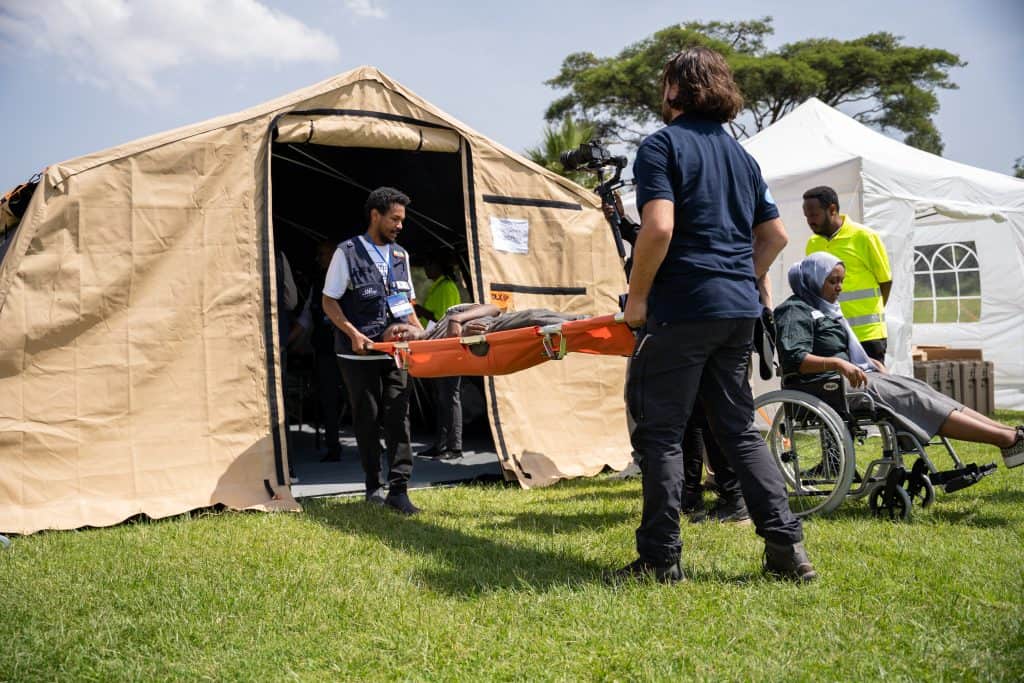
Addis Ababa (HN24) – Ethiopia conducted a full scale health emergency simulation exercise on November 2 in Addis Ababa. The drill precedes the seventh World Health Organization Emergency Medical Teams Global Meeting scheduled for November 3 through November 5 at the Ethiopian Skylight Hotel. The gathering marks the first time the global summit takes place in Africa.
The Ethiopian Public Health Institute, the Ministry of Health, and the World Health Organization organized the full scale health emergency simulation, which took place November 2 at Afro Center Hospital in Bole Bulbula, Addis Ababa. The drill assessed the national coordination mechanisms and operational performance under field conditions. Authorities aimed to identify operational vulnerabilities and reinforce institutional preparedness to handle disease outbreaks and natural disasters before emergencies occur.
Addis Ababa is currently hosting the seventh World Health Organization Emergency Medical Teams Global Meeting from November 3 to November 5 at the Ethiopian Skylight Hotel, bringing together nearly 800 participants from 100 countries. The conference represents the inaugural instance of the summit being held on the African continent, following the sixth edition hosted in Abu Dhabi in November 2024. The upcoming assembly follows the official international classification of the Ethiopian National Emergency Medical Team as a verified civilian emergency medical team under World Health Organization standards.
The three day event will assemble policymakers, emergency response coordinators, researchers, and field practitioners representing international emergency medical teams. Delegates plan to evaluate evolving clinical care protocols, operational frameworks, and strategic logistics required to assist populations during health emergencies. Professor Thierno Balde, Head of the Emergency Programme at the World Health Organization Ethiopia Country Office, noted that effective disaster response requires integrating medical knowledge with logistical execution across civilian and military sectors.
The World Health Organization established the Emergency Medical Teams Initiative following the 2010 earthquake in Haiti to address critical gaps in international medical assistance deployment. The program focuses on standardizing field medical practices, ensuring operational self sufficiency, and enhancing coordination between host governments and foreign medical teams during sudden onset disasters.